


This tool was developed as a joint effort of the Metabolic Research Laboratory, Clínica Universidad de Navarra and Tecnun School of Engineering, Universidad de Navarra, to help healthcare professionals in the estimation of the likelihood of Roux-en-Y bariatric surgery success based on patient-specific pre and perioperative data (see below for the needed input variables). By leveraging three Machine Learning (ML) models to choose from, this tool provides success/failure predictions along with probability success score. These models have been trained using surgery outcome at 18 months measured by the following two metrics:
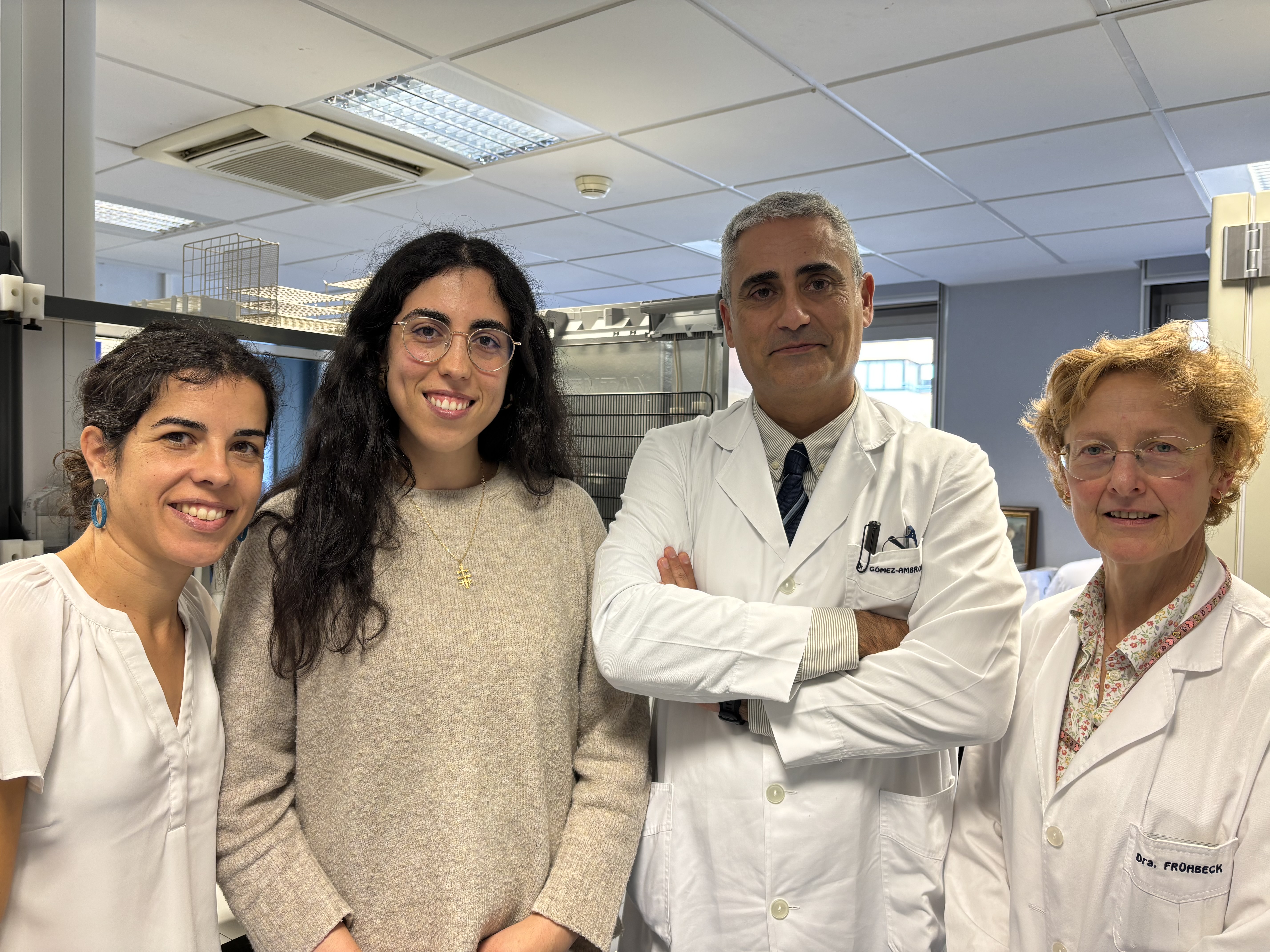
members of the research group from left to right
1. Prepare your CSV file containing patient data. ML models Model 1 & Model 2, based on BMI, need as input 16 variables (see provided test_data_1_2.csv file in GitHub for an example). ML model Model 3, based on EWL, needs as input 58 variables (see provided test_data_3.csv file in GitHub for an example). The tool expects a .csv file following the structure of the provided examples. In the first case, predictions for Model 1 and Model 2 will be computed; whereas in the second case only predictions for Model 3 will be computed. In all cases, the models will analyze the input and predict the probability of treatment success.
2. Upload your CSV file to the dropzone on the right.
3. Results of the predictions will be added as new columns in a newly generated .csv (one per model run), including:
1. Manually introduce each variable’s values for one patient in the windows included below.This option will only provide a prediction using Model 1 & Model 2, with their 16 input variables. Decimal used must be a dot “.”.
2. Press “send” and the prediction will appear on screen
“Roux Limb” and “Treitz” are perioperative anatomical landmarks, that is, defined during the surgery. Please enter in your .csv file whichever value you would like to evaluate for each individual patient, taking into account that a higher value means a more aggressive surgery. In particular:
📂 Download your file example to run the model !
📂 Upload your file to get started!